BoroTech Solution designed and built a two-sided platform for a secondhand two-wheeler financing business: an internal Operations Console for the finance team, and a customer-facing mobile app so every borrower can track their own loan — covering the full lifecycle from application intake through disbursal, EMI collection and reporting.
Discuss a Similar Project
The client runs a financing business built around secondhand two-wheelers — motorcycles and scooters purchased on installment plans through local showrooms. Businesses like this typically start out managing loan files, EMI collection and customer follow-ups manually — across registers, spreadsheets and phone calls — which makes it hard to see the true state of the loan book at any given moment or give customers visibility into what they owe.
We designed and built a two-sided platform for this business: an internal Operations Console for the finance team, and a customer-facing mobile app so every borrower can track their own loan. Together they cover the full loan lifecycle — application intake, guarantor and showroom verification, disbursal, EMI scheduling, multi-channel payment collection, verification, and portfolio reporting.
The client sources used motorcycles and scooters, partners with local showrooms and guarantors, and finances the purchase for the end customer over a fixed tenure — typically a short window of a few months with a down payment, monthly EMIs, processing fee, and applicable charges and GST. Vehicles, showrooms and guarantors are all recorded against each loan file, since repossession and recovery in this business depend on knowing exactly who holds the vehicle and who vouched for the customer.
Without a connected system, a lending business like this typically runs into the same set of gaps.
No single, live view of how much is out on loan, how much has been collected, and how much is still outstanding.
Cash, bank transfer and QR collections have to be manually reconciled against the correct loan and EMI number, with no built-in audit trail of who confirmed the payment.
Onboarding a customer means re-keying the same details — personal, vehicle, guarantor, showroom, loan terms — across separate paper or spreadsheet records.
Borrowers have no way to check their EMI schedule, dues, or payment history without calling the office.
Branch or field staff have no controlled way to work inside the system, and there's no record of who approved or edited what.
We delivered a single connected system with two front ends sharing one source of truth for every loan.
A web-based console for the finance and operations team to create loan applications, review and approve them, verify payments, and monitor the whole portfolio.
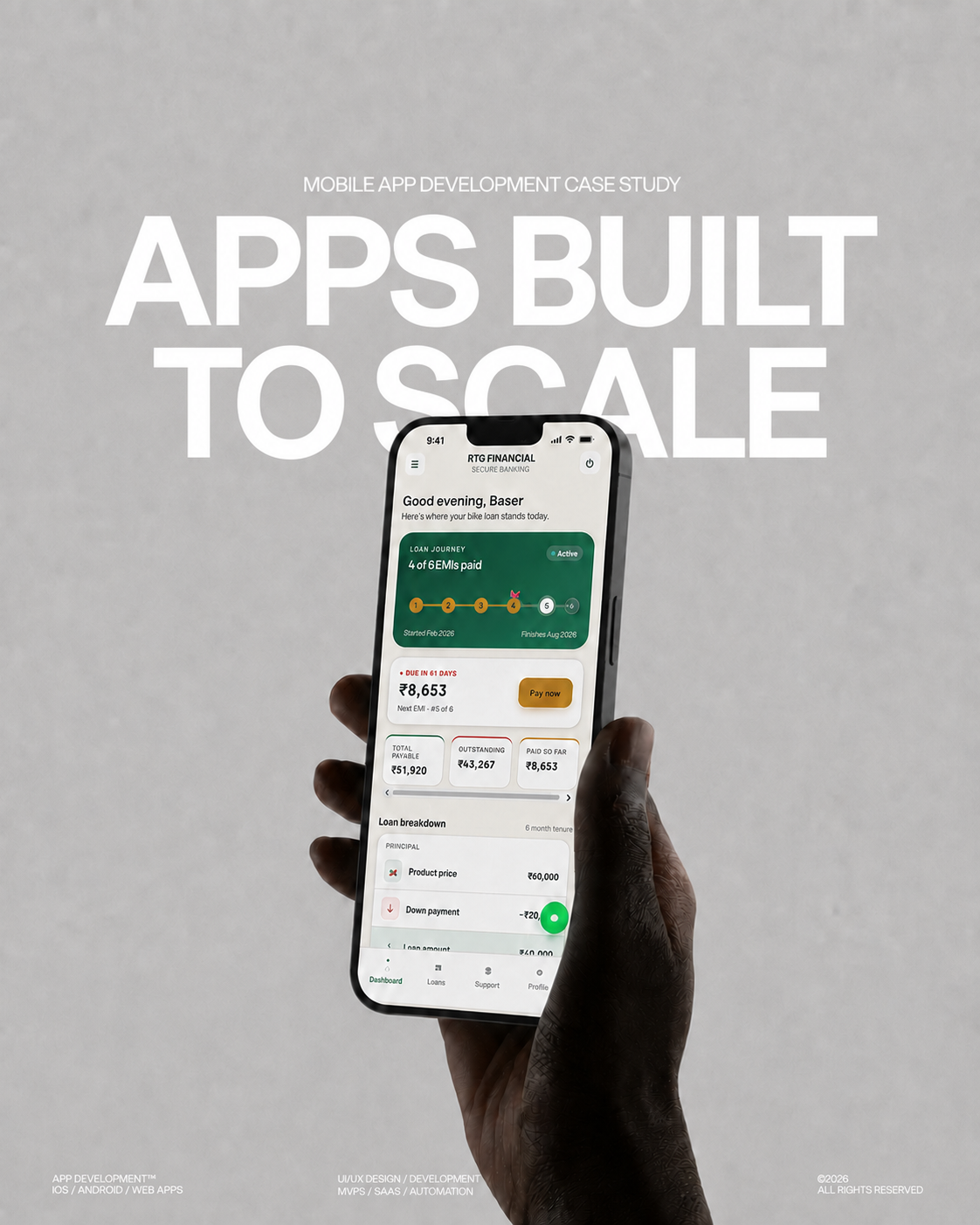
A mobile app that gives each borrower a live view of their own loan — EMI schedule, dues, vehicle and guarantor details, and a one-tap way to pay.
Both are built on the same loan, customer and payment records, so an EMI confirmed in the console updates the customer's app instantly, and a payment initiated by the customer shows up in the admin's verification queue.
The console is organised around the day-to-day rhythm of a lending desk: bring in new applications, move them through approval, activate the loan, collect and verify EMIs, and report on the book — with dedicated areas for customers, guarantors/showrooms, staff and an activity log for accountability.
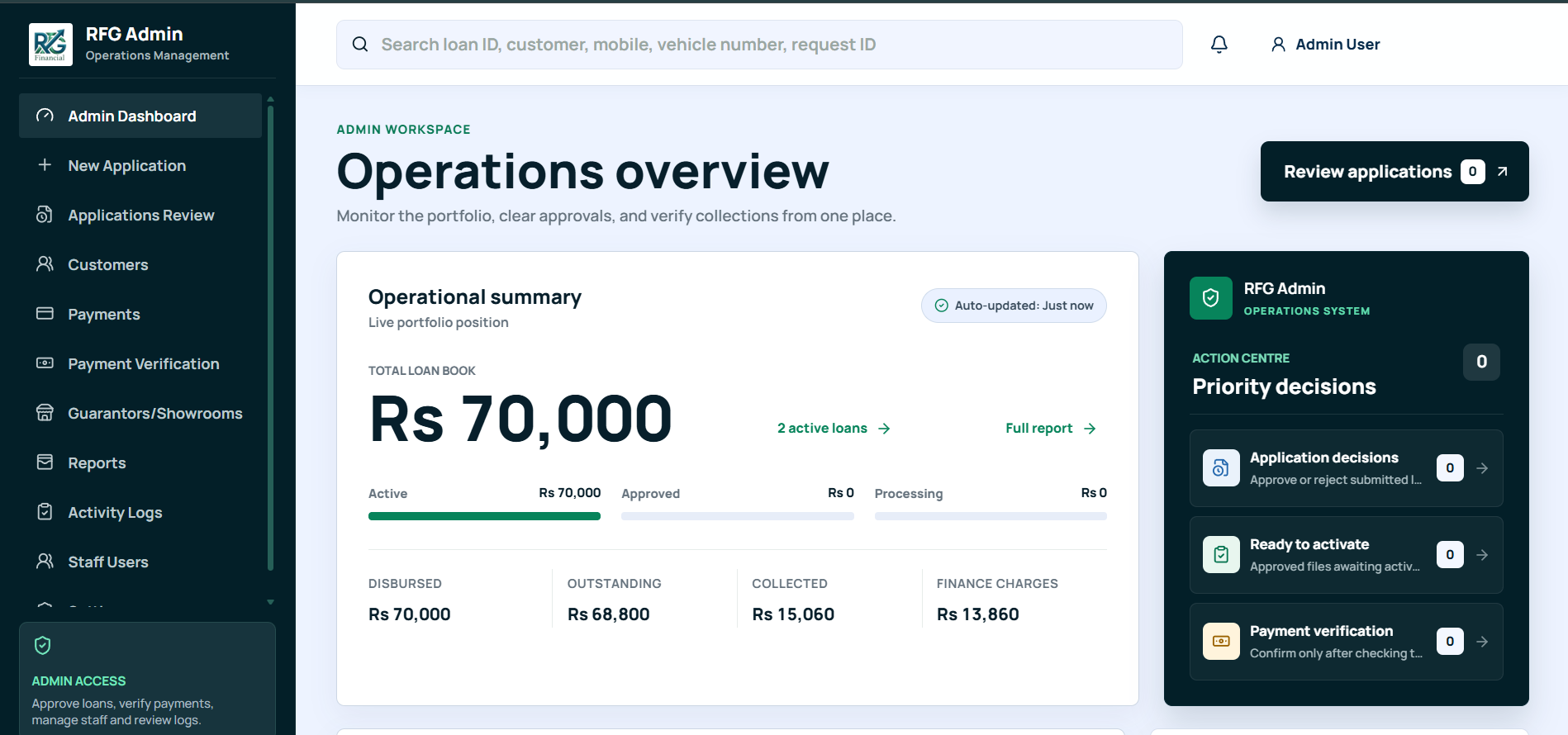
The landing dashboard gives the team a live read on the portfolio the moment they log in: total loan book value, how much of it is active versus approved versus still processing, and the split between disbursed, outstanding, collected and finance-charge amounts. An "Action Centre" panel on the right surfaces exactly what needs a decision right now — pending application decisions, files that are approved and ready to activate, and payments waiting on verification — so nothing sits unattended in a queue.

Operations Overview — live portfolio position and a prioritised action centre for pending decisions
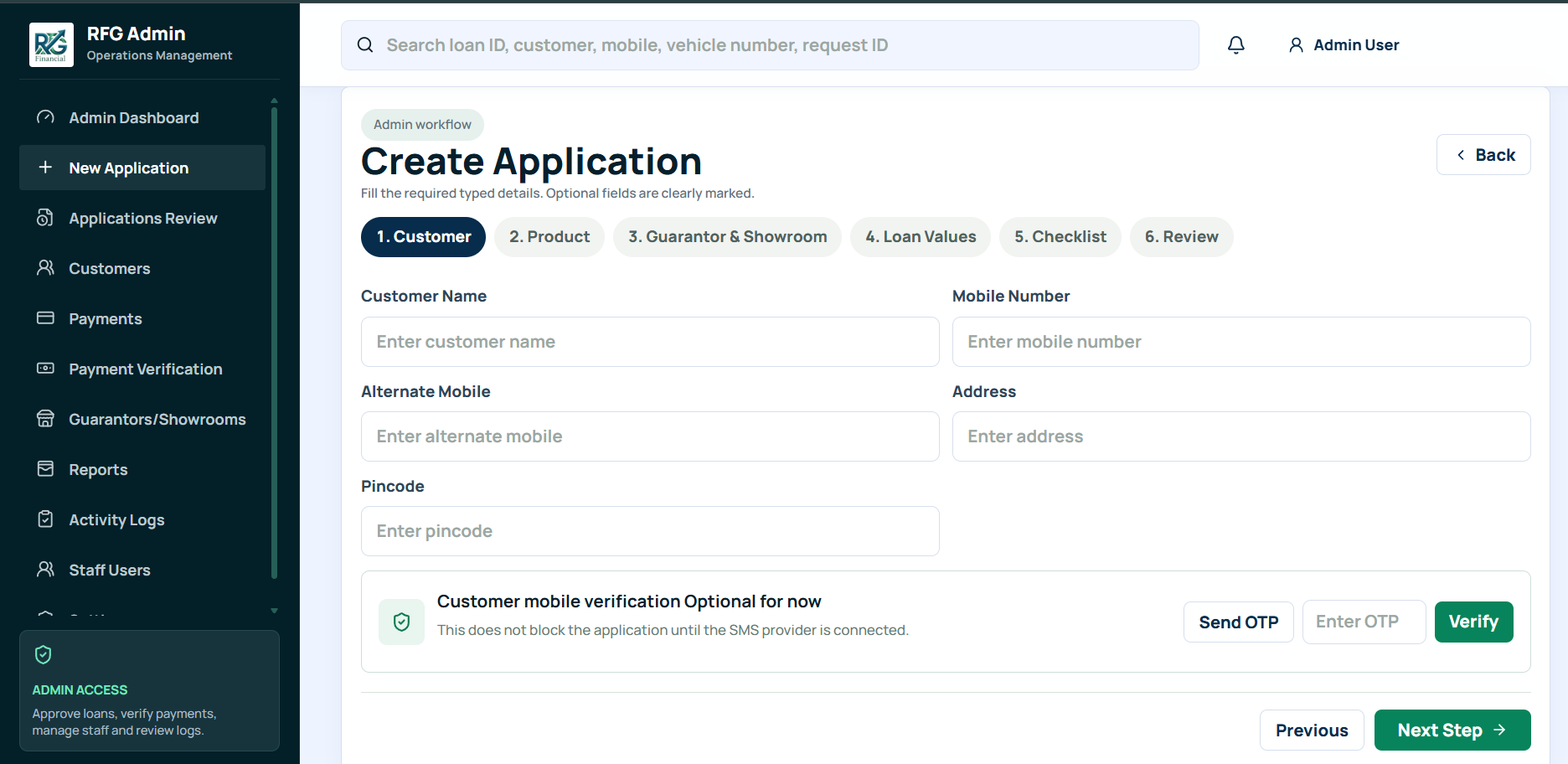
New loans are created through a six-step guided wizard — Customer, Product, Guarantor & Showroom, Loan Values, Checklist, and Review — so every file is captured in the same structure regardless of which staff member opens it. The customer step captures name, mobile, alternate mobile, address and pincode, with optional mobile OTP verification built in so the workflow isn't blocked while a live SMS provider is still being connected. Because the later steps sit in the same flow, every application arrives at the review stage with a consistent, complete file — which is what makes fast approval decisions possible downstream.

Create Application — a six-step wizard from customer details through to final review
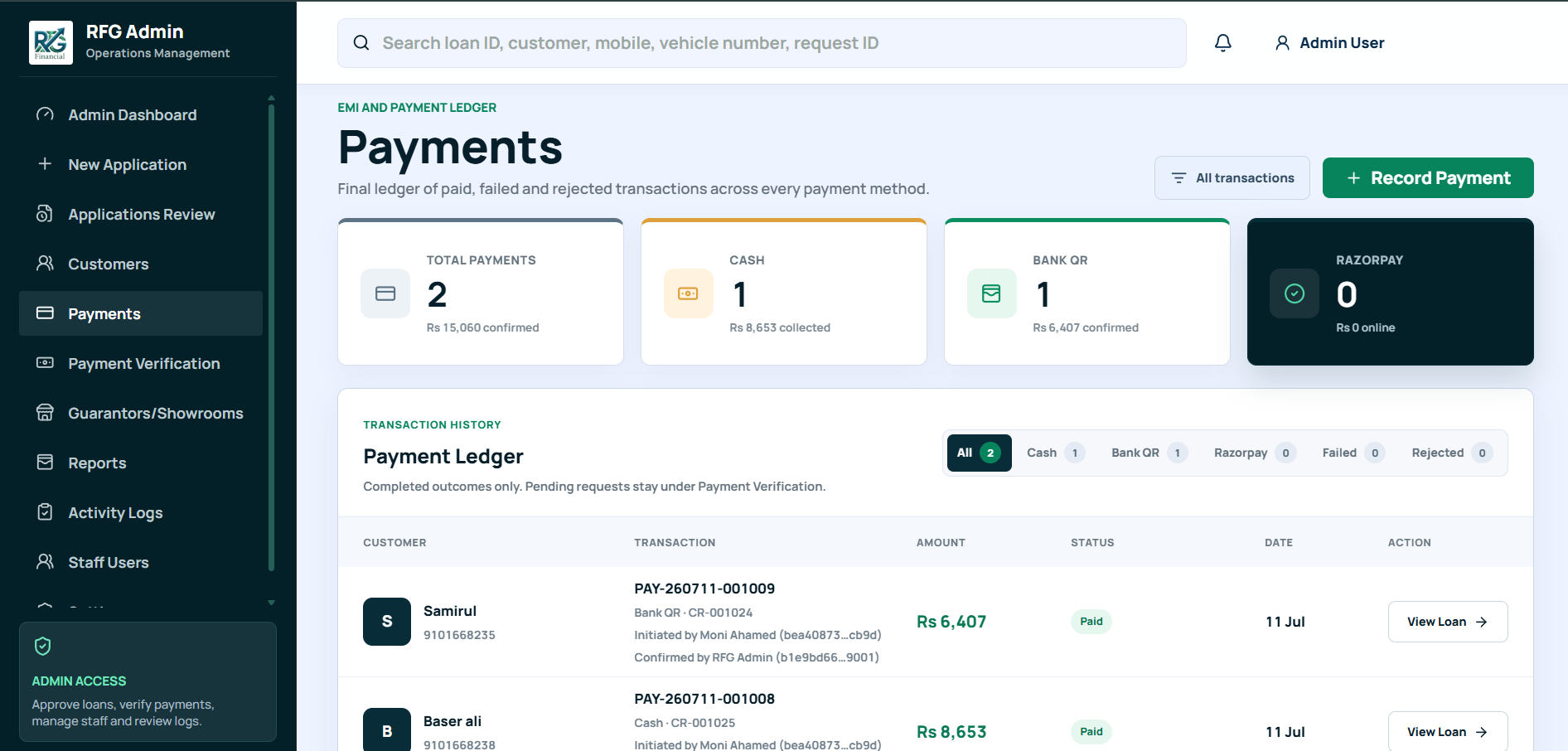
All collected EMIs land in one ledger, tagged by channel — cash, bank QR, or Razorpay for online payments — with running totals for each. Every transaction records who initiated it and who confirmed it (for example, a cash EMI collected by a field staff member and then confirmed by an admin), which gives the business a clear audit trail on money handled outside digital rails. A separate Payment Verification area exists specifically so that cash and QR payments are only counted once an admin has checked and confirmed them — keeping the reported collection figures trustworthy.

Payments — a channel-wise ledger of confirmed EMI collections with initiator/confirmer audit trail
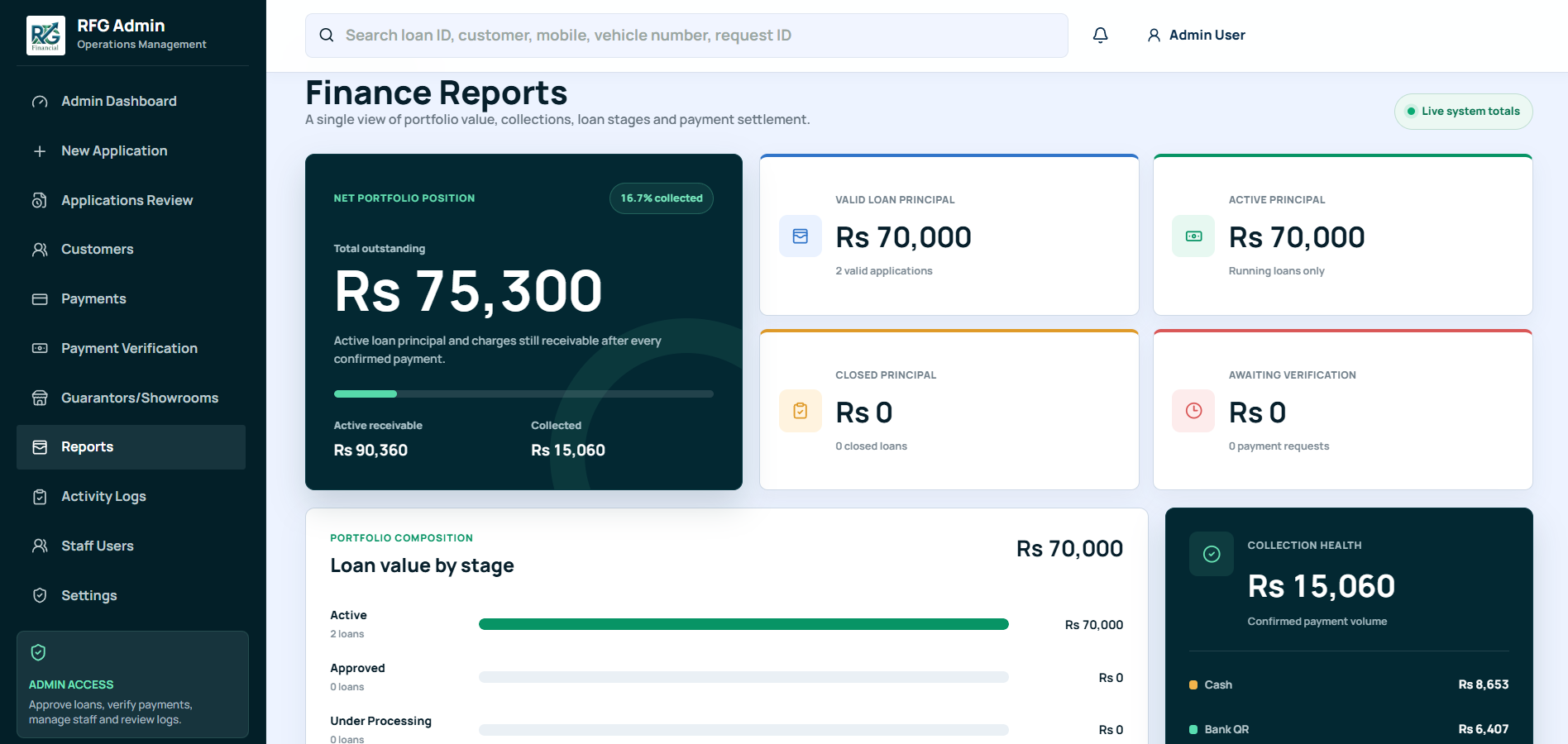
The Reports module rolls everything up into a single financial picture: net portfolio position, valid and active loan principal, closed principal, and amounts still awaiting verification. A portfolio composition view breaks the loan book down by stage (active, approved, under processing), and a collection health panel shows how collected value splits across cash, bank QR and other channels — giving the business owner a real-time answer to "where does the book stand today" without waiting on a manual reconciliation.

Finance Reports — net portfolio position, loan-stage composition and channel-wise collection health
| Module | What It Does |
|---|---|
| Applications Review | Queue for approving or rejecting submitted loan files before they move to activation. |
| Customers | Central record of every borrower, searchable by name, mobile, loan ID or vehicle number. |
| Guarantors / Showrooms | Directory of the partner showrooms and guarantors tied to each financed vehicle. |
| Activity Logs | A log of key actions taken across the system, for accountability. |
| Staff Users | Manage the team members who have access to the admin console. |
Every borrower gets a personal, secure view of their loan on their phone — replacing phone calls to the office with a simple dashboard they can check any time.
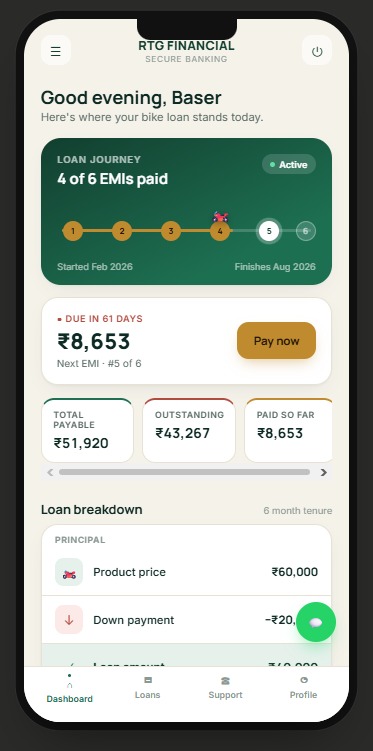
On opening the app the customer sees a personal greeting and a visual loan journey — a track of EMI markers showing exactly how many instalments are paid and how many remain against the agreed tenure. Below it, the next due amount, a countdown of days remaining, and a one-tap "Pay now" button; and below that, a quick summary of total payable, outstanding balance and amount paid so far.

Customer Dashboard — loan journey tracker, next EMI due date and a one-tap Pay now
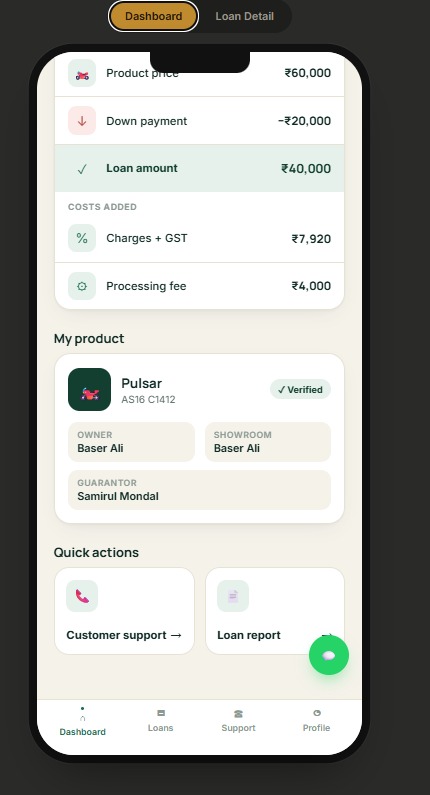
Scrolling down, the customer can see exactly how their loan amount was built up — product price, down payment, resulting loan amount, and the charges/GST and processing fee added on top — so there is never ambiguity about how the EMI figure was reached. The same screen ties the loan to the specific vehicle (make, model and registration), the showroom it was purchased through, and the guarantor on file.

Loan Breakdown — product price, down payment, charges and processing fee, plus the linked vehicle, showroom and guarantor
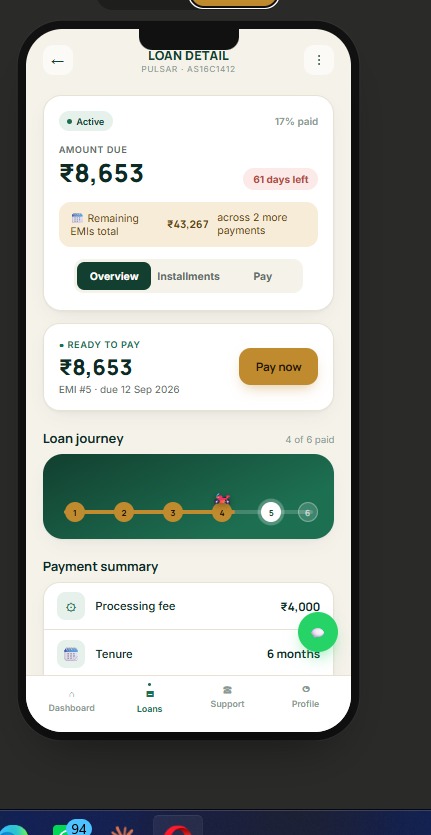
A dedicated Loan Detail screen gives a closer view of a single loan: amount currently due, days remaining, how many EMIs are left and their combined value, and the same visual journey tracker seen on the dashboard. Overview, Installments and Pay are separated into their own tabs so a customer can either check their schedule or jump straight to paying without extra taps.

Loan Detail — amount due, days remaining and the EMI journey tracker for a single loan
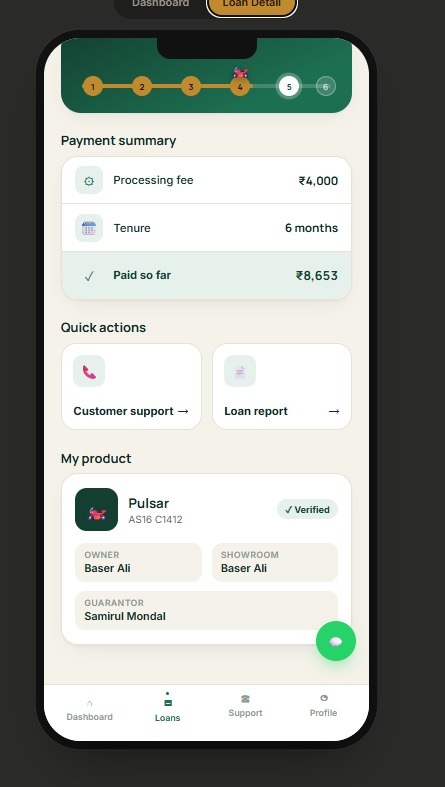
Further down, a payment summary recaps the processing fee, tenure and amount paid to date, and two quick actions give the customer a direct line to customer support and access to a loan report — reducing reliance on phone calls to the office for basic status checks.

Payment Summary — fees, tenure and paid-to-date, plus quick actions for support and the loan report
The meaningful shift the platform delivers is qualitative: applications are captured once, consistently, instead of being re-keyed across paperwork; every rupee collected in cash or by QR carries an audit trail of who took it and who confirmed it; the finance team can see the full portfolio's stage, collection and outstanding position in one screen instead of reconciling it manually; and borrowers can check their own EMI status and pay directly from the app instead of calling in — freeing the operations team to focus on approvals, verification and recovery rather than status updates.
A responsive admin console (desktop-first, for branch and back-office use) paired with a mobile-first customer app, both reading and writing to one shared loan/customer/payment data model.
Cash, bank QR and Razorpay (online) are all first-class channels in the same ledger, each reconciled through a verification step before it counts toward collections.
A structured, multi-step application wizard plus a review/approval queue keeps every loan file complete and consistent before money moves.
Role-based staff accounts and a system-wide activity log so every approval, verification and edit is attributable.
A portfolio-level reports view (net position, principal by stage, collection health) built directly on live transaction data rather than a periodic manual export.
This project replaced a manual, spreadsheet-and-phone-call operation with a connected system that gives a secondhand two-wheeler finance business a live, trustworthy view of its loan book on one side, and gives its customers a transparent, self-service view of their own loan on the other. The result is a platform built specifically around how this business actually operates — vehicles, showrooms, guarantors, EMIs and cash collections — rather than a generic loan tool bent to fit.
BoroTech Solution designs and builds admin consoles paired with customer-facing apps, tailored to how your lending or financing business actually runs.