A fully custom ERP platform built for IT Futuristics Industries Pvt. Ltd.
BoroTech Solution designed and built a ground-up, cloud-hosted ERP system — 10 fully integrated modules covering sales, inventory, procurement, finance, HR, field operations, fleet management, reporting, WhatsApp communication, and audit security — replacing paper registers, spreadsheets, and disconnected WhatsApp workflows with one unified platform.
ClientIT Futuristics Industries Pvt. Ltd.
IndustryElectrical & Electronic Goods Trading
LocationNagaon, Assam, India
PlatformCustom-built, Cloud-hosted ERP on Private VPS
IT Futuristics Industries Pvt. Ltd. (ITFI) is a mid-sized enterprise based in Nagaon, Assam, engaged in the trading and distribution of electrical and electronic goods. As the business scaled, its reliance on manual processes, disconnected spreadsheets, and paper-based workflows created compounding operational bottlenecks across procurement, sales, inventory, HR, and finance.
The company commissioned a fully custom-built, cloud-hosted ERP system — developed ground-up with no off-the-shelf components — and deployed on a private Virtual Private Server (VPS). The goal was to unify all business operations into a single integrated platform, purpose-built for Indian SME trading and distribution realities, including full GST compliance, FIFO inventory costing, and mobile-accessible interfaces.
Seven functions, all running on paper and spreadsheets
Prior to ERP implementation, ITFI's operational structure was fragmented across paper registers, standalone Excel spreadsheets, and manual WhatsApp communications — with no shared data layer, creating duplication of effort, frequent errors, and an inability to make timely, data-driven decisions.
Challenge Area
Situation Before ERP
Inventory
Stock levels tracked in Excel, frequently mismatched with physical stock.
Sales & Quotations
Quotes drafted manually in Word, emailed as PDFs with no tracking or follow-up.
Accounts Receivable
Outstanding customer balances tracked in paper notebooks.
Procurement
Purchase orders raised without visibility into actual stock levels.
Payroll
Attendance on paper registers; salary calculations done manually in Excel.
Financial Reporting
P&L and balance sheet prepared quarterly by external CA with weeks of delay.
Audit Trail
No record of who changed what, when, or why.
Strategic Consequences
Management had no real-time visibility into cash position, outstanding receivables, or inventory availability.
Sales executives spent disproportionate time on admin tasks rather than customer engagement.
Procurement was entirely reactive, with no automatic signals when stock fell below thresholds.
Financial reporting was a periodic event rather than a continuous management tool.
Zero accountability trail — data errors or unauthorized changes could not be traced.
Payroll cycles were error-prone and time-consuming, risking under- or over-payment.
Project Goals & Objectives
Five outcomes the platform was scoped to deliver
Unify procurement, sales, inventory, finance, HR, field operations, fleet management, reporting, communication, and security into one platform.
Replace paper- and spreadsheet-based workflows with a cloud-hosted system accessible from any desktop or mobile browser.
Provide real-time, role-appropriate visibility into stock, sales pipeline, receivables, payables, cash, payroll and performance.
Improve document accuracy through financial-year aware numbering and automated, GST-aware PDF generation.
Build a scalable, fully owned platform — no per-user SaaS licensing fees, no vendor lock-in, full data ownership.
System Architecture
A three-tier platform, built for scale and ownership
Web browser — desktop and mobile (no native app required)
Authentication
Role-based: Admin, Sales Manager, Accountant, Field Staff, Employee
Document Numbering
Financial-year aware, IST timezone, month-segmented (e.g. HE-Q/2026-27/04/0001)
PDF Generation
Client-side jsPDF with shared company letterhead constants
Database
Single unified PostgreSQL instance — one source of truth for all modules
Deployment Model
Self-hosted, fully owned — zero recurring per-user SaaS licensing fees
Key Architectural Decisions
01
Single Database, All Modules
All 10 modules share one PostgreSQL instance, eliminating data duplication entirely — a stock movement immediately reflects in Finance's COGS, Procurement's reorder trigger, and Reports.
02
Financial-Year Aware Numbering
Every document carries a structured reference incorporating FY (April–March), month, and sequential counter, computed in IST timezone.
03
Private VPS Hosting
Full server control, custom process management (PM2), and zero per-user licensing cost as the organization scales.
04
Client-Side PDF Generation
Quotations, POs, GRNs, challans, invoices and payslips generate client-side via jsPDF with a shared letterhead constant file.
05
Role-Based Security Architecture
Access governed at the route level by user role, preventing unauthorized access while enabling self-service per user type.
Module-by-Module Documentation
Ten modules, each replacing a real manual workflow
Module 01
Sales & CRM
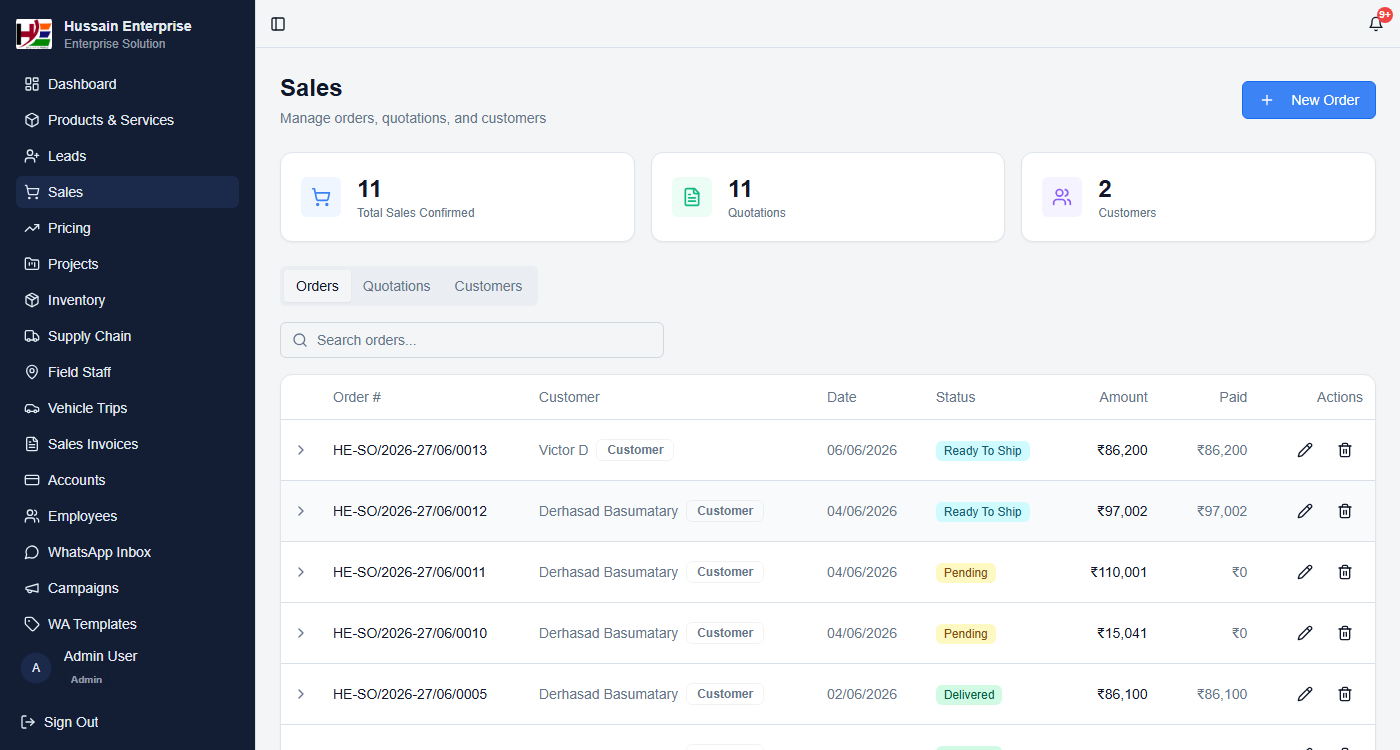
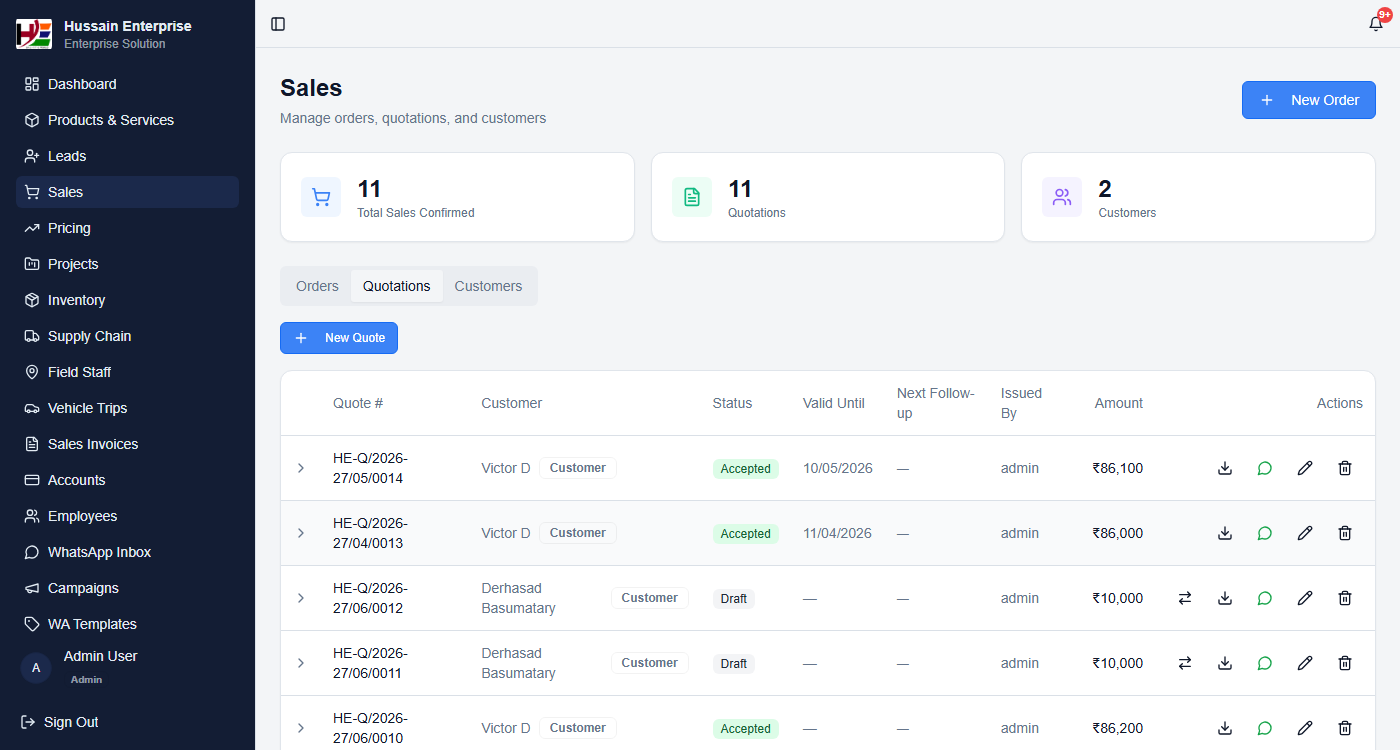
Manages the complete sales lifecycle — from lead capture through quotation, order confirmation, dispatch, and payment recording. Before ERP, this was handled through Word documents, email, and WhatsApp, with no tracking, follow-up automation, or pipeline visibility.
Leads Management
Sales Orders Management
Quotation Module with auto-GST calculation
Payment Recording against orders
Quotation PDF generation (instant)
SO Advances (advance payment tracking)
Follow-up Tracking & Reminders
Customer database with transaction history
Real-world impact: Before ERP, a sales executive spent 30–45 minutes preparing a single quotation in Word — manually calculating GST, formatting, printing, scanning. With the ERP, a GST-compliant quotation is generated in under 3 minutes as a branded PDF. Built-in follow-up reminders eliminated missed callbacks.
Module 02
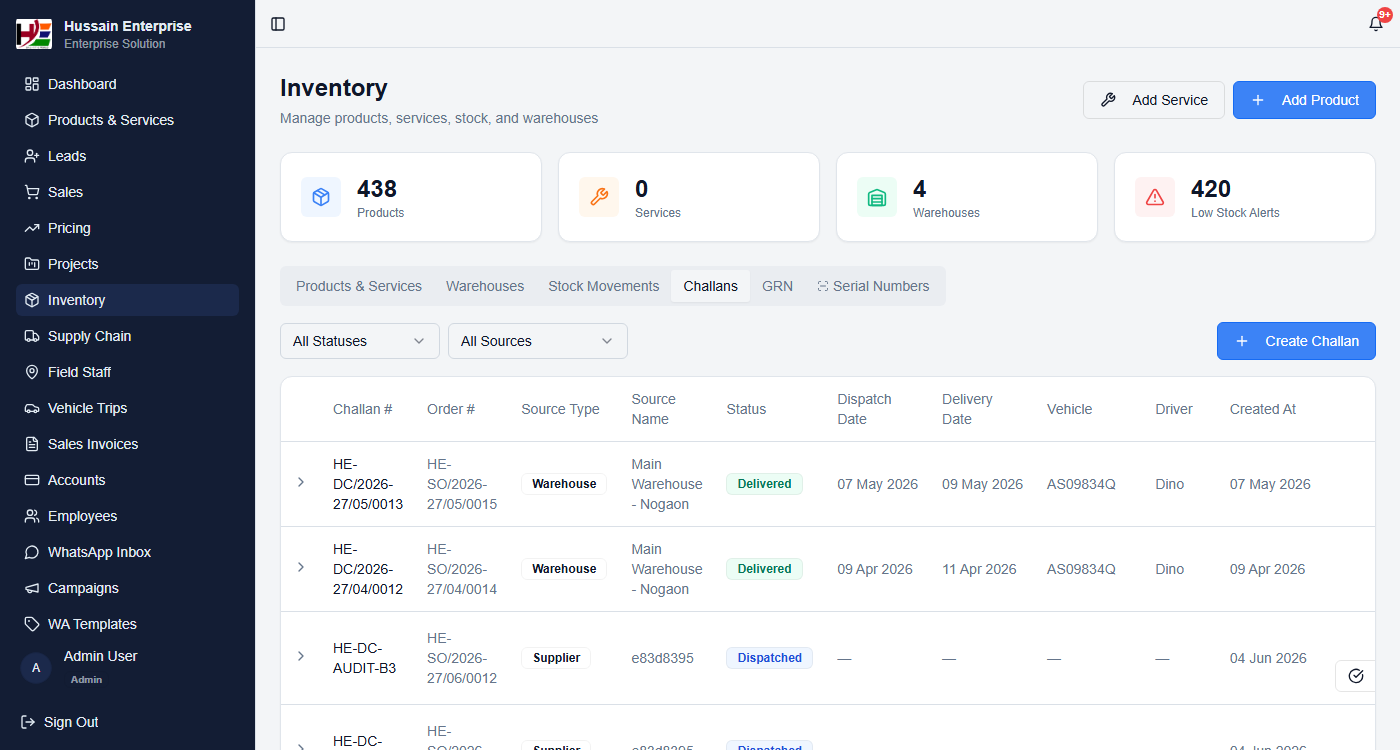
Inventory & Warehouse Management
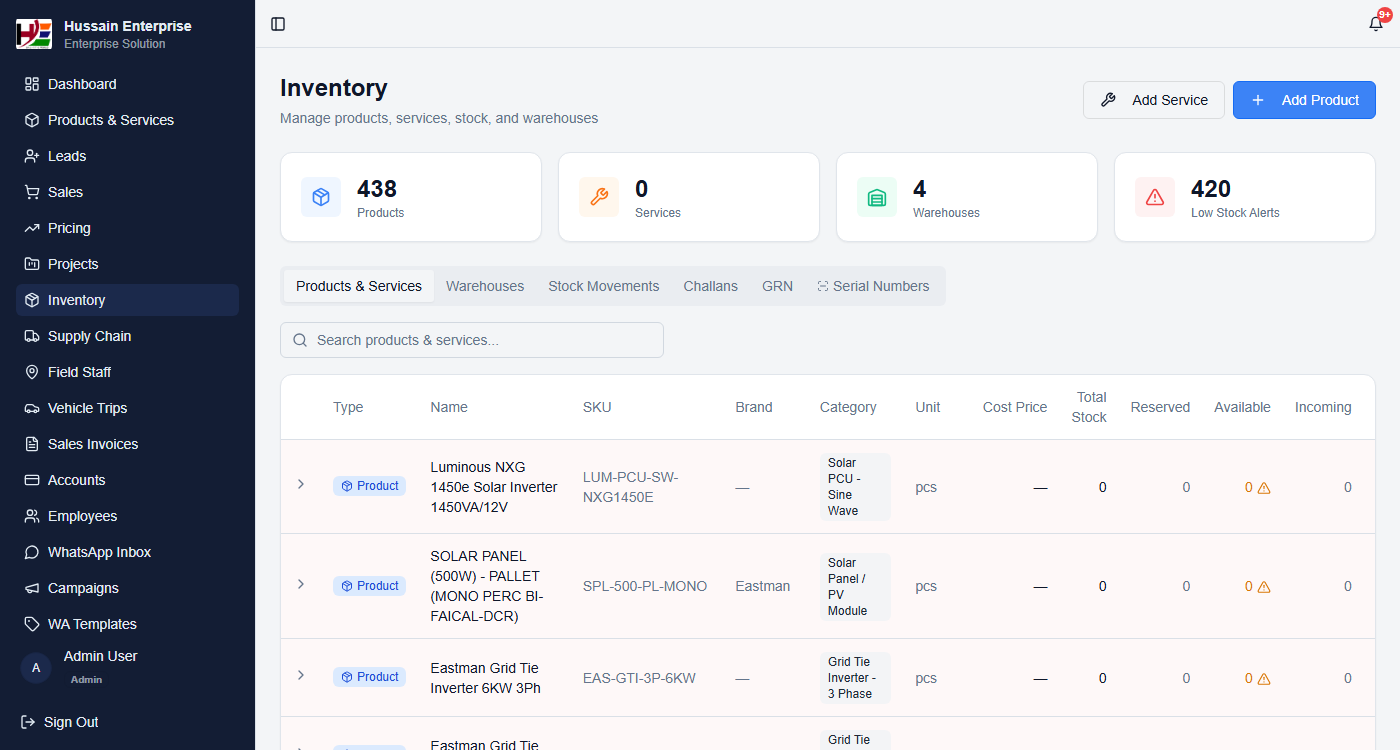
Complete visibility and control over ITFI's product catalogue, multi-warehouse stock positions, inbound goods tracking, dispatch operations, and stock movement history. Before ERP, stock levels lived in isolated Excel files with no ability to trace a discrepancy to a specific transaction.
Product Catalogue (438+ SKUs)
Multi-Warehouse Support (4 locations)
Real-time Stock Levels with low-stock alerts
Serial Number Tracking per unit
Combo / Bundle Serial Tracking
Delivery Challans with PDF generation
GRN (Goods Receipt Note) integration
FIFO Lot Engine for accurate COGS
Real-world impact: Stock discrepancies that once took days of manual cross-referencing are now traceable to the exact GRN lot and dispatch challan in seconds. The FIFO lot engine ensures COGS always reflects the actual purchase cost of each lot consumed.
Module 03
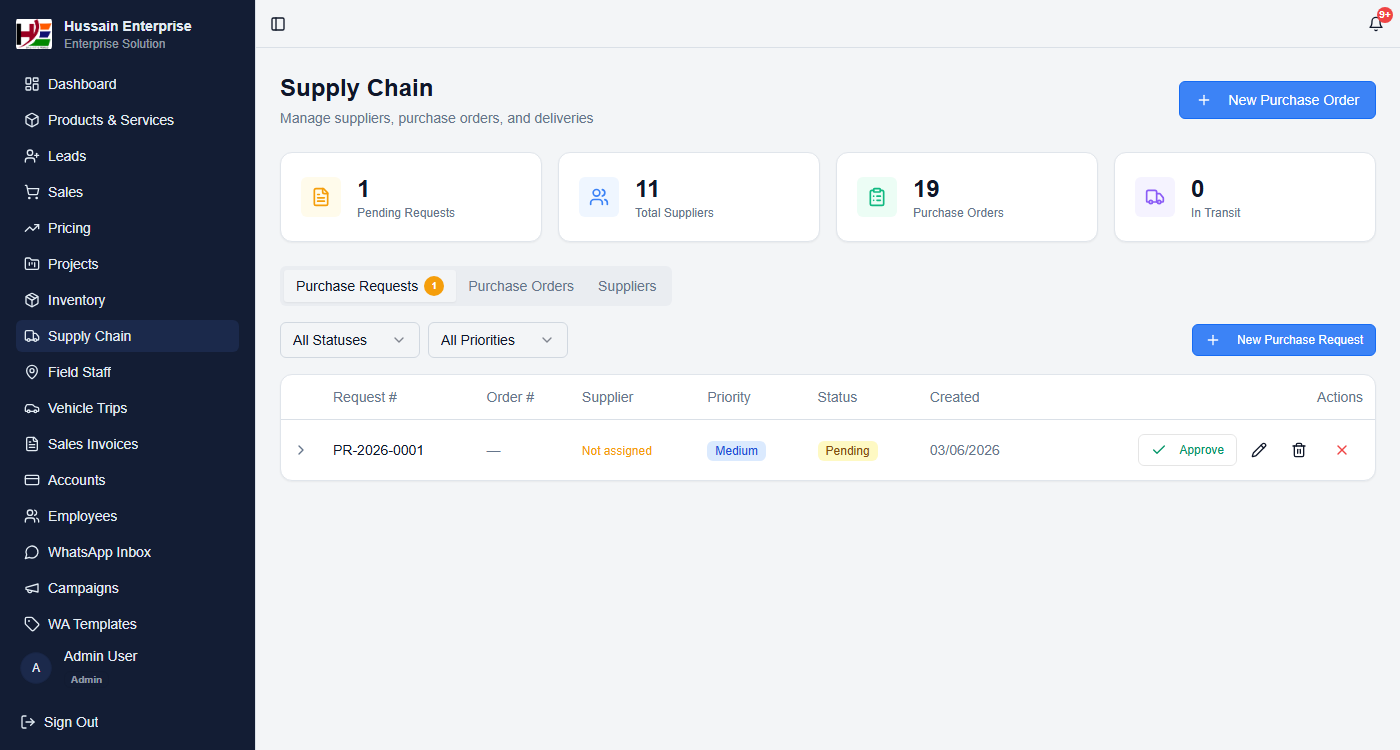
Supply Chain & Procurement
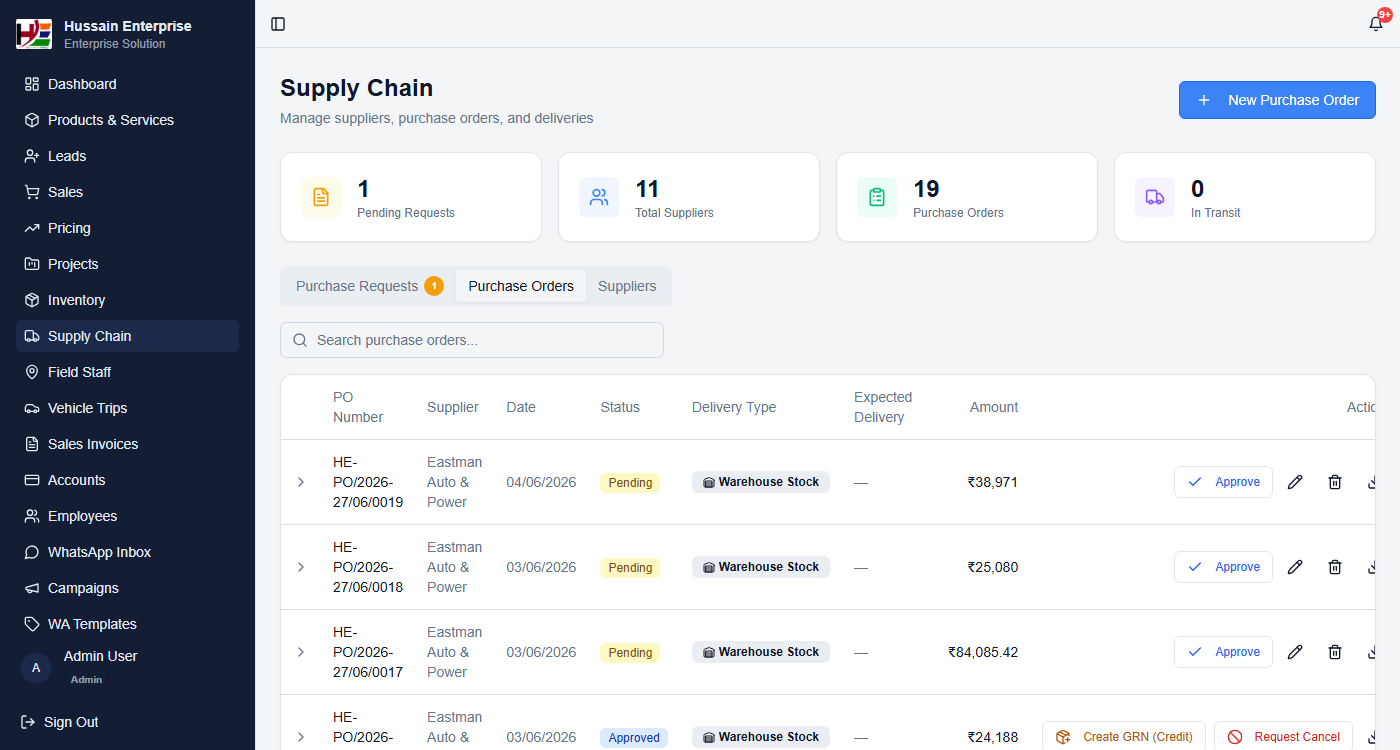
Manages the end-to-end procurement lifecycle — automated purchase request triggers, supplier selection, PO creation and approval, goods receipt, and supplier invoice recording. Before ERP, procurement was entirely reactive.
Purchase Requests with priority levels
Purchase Orders (PO) management
PO Approval Workflow
GRN processing + PDF for supplier confirmation
Supplier Invoice Recording & Payment Tracking
Auto Purchase Request on stock depletion
Real-world impact: The auto-purchase request trigger changed ITFI's procurement model from reactive to proactive. PO-to-GRN matching eliminated supplier invoice disputes, and outstanding balances are now visible in real time.
Module 04
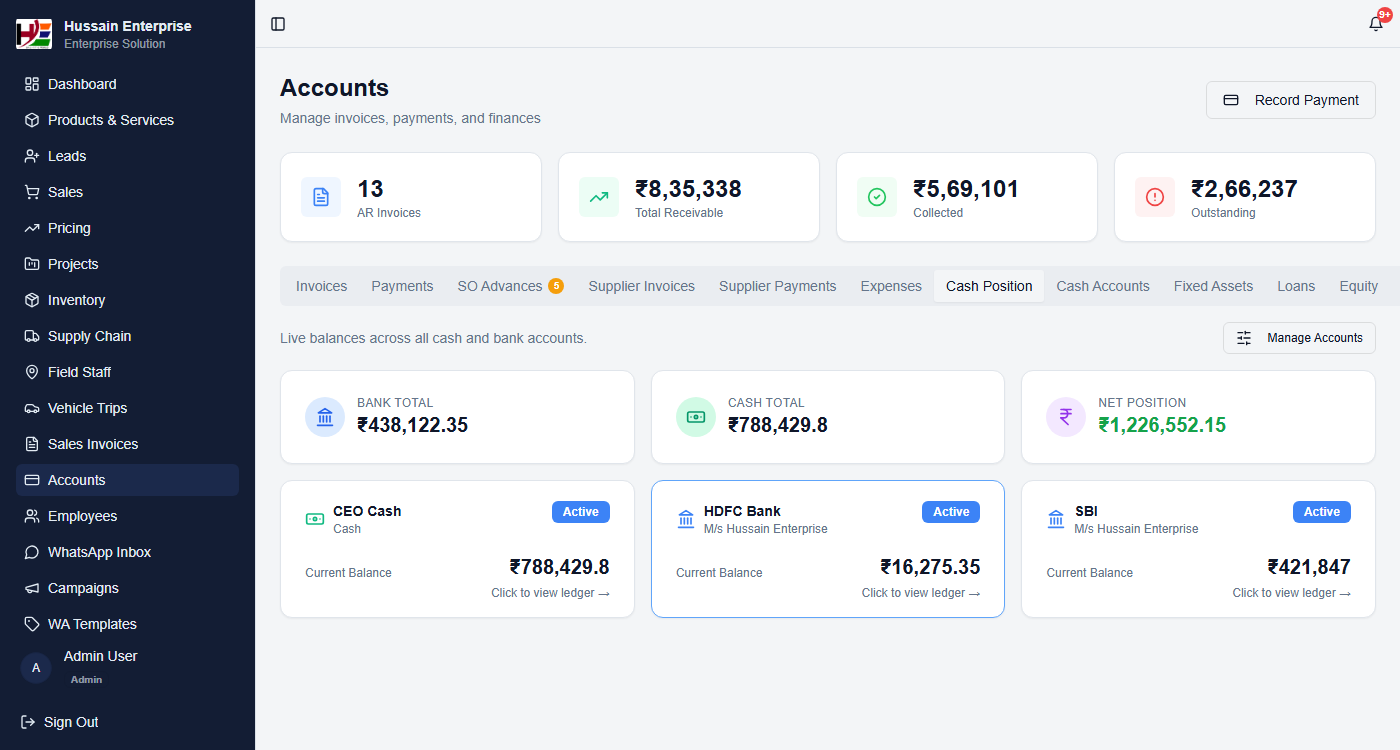
Accounts & Finance
Consolidates all monetary flows — receivables, payables, cash, expenses, fixed assets, loans, and equity — into one integrated system. Before ERP, financial reporting was a quarterly exercise conducted by an external CA with weeks of processing time.
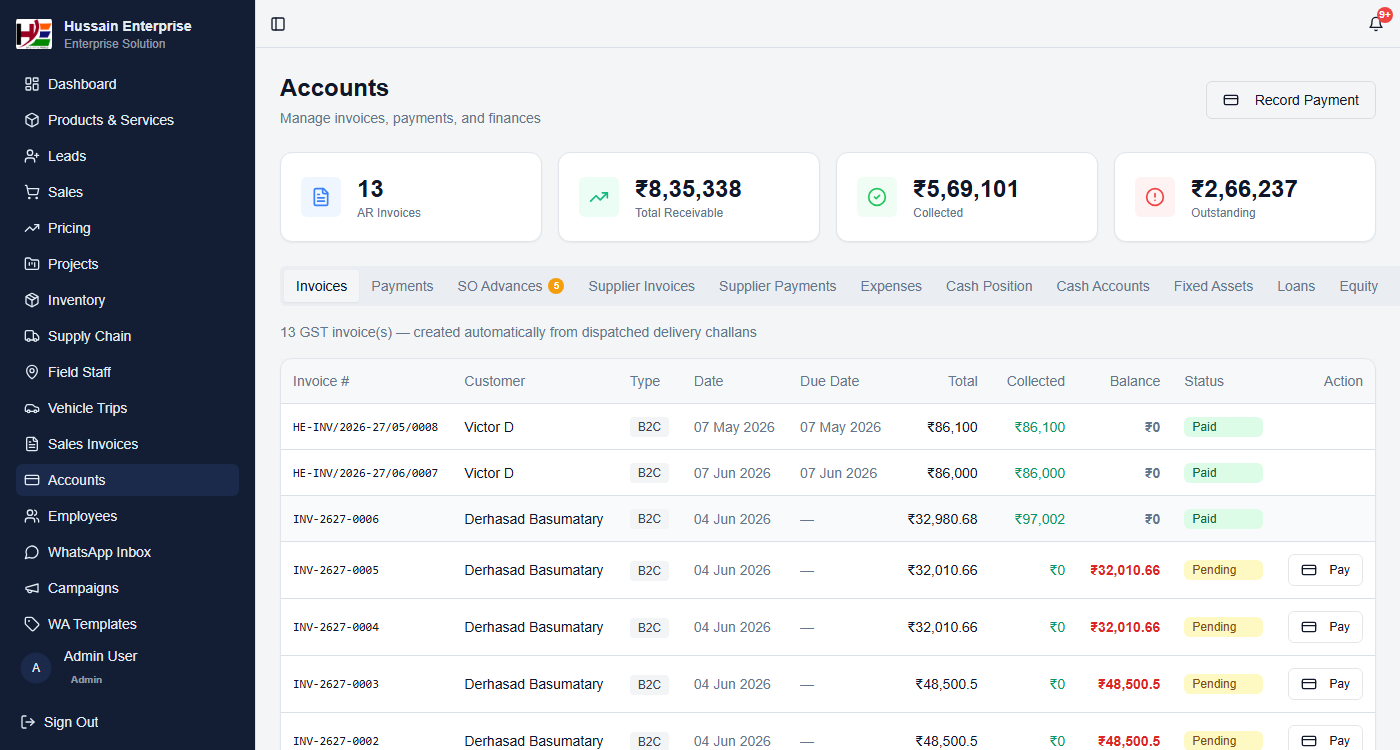
Sales Invoices (auto-generated on dispatch)
AR Aging by customer
Live Cash Position dashboard
Live P&L Statement
Balance Sheet & Cash Flow Statement
Fixed Assets, Loans & Equity management
GST Tax Summary export
Sales & Purchase Registers + CSV export
Real-world impact: Management now has live access to P&L, balance sheet, and cash position at any moment from any browser. The GST register export reduced return preparation from multiple days to under an hour.
Module 05
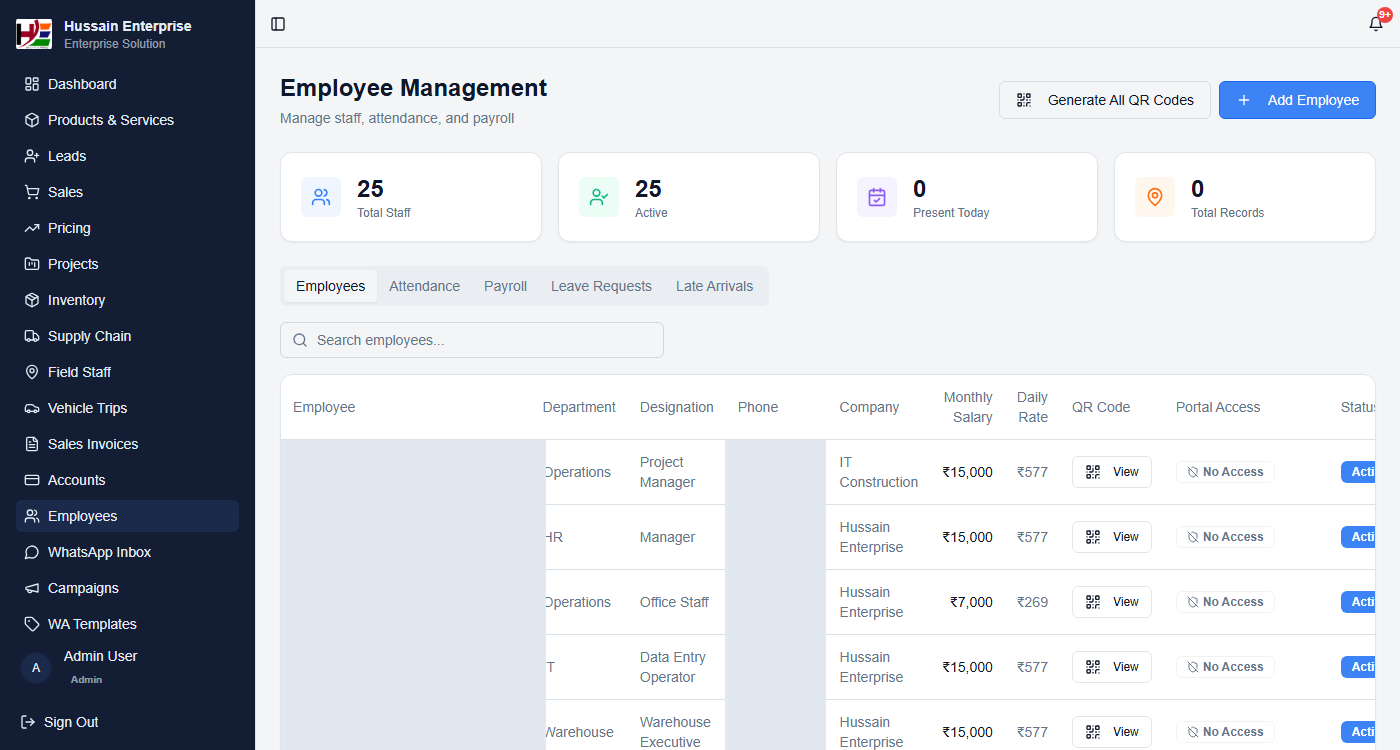
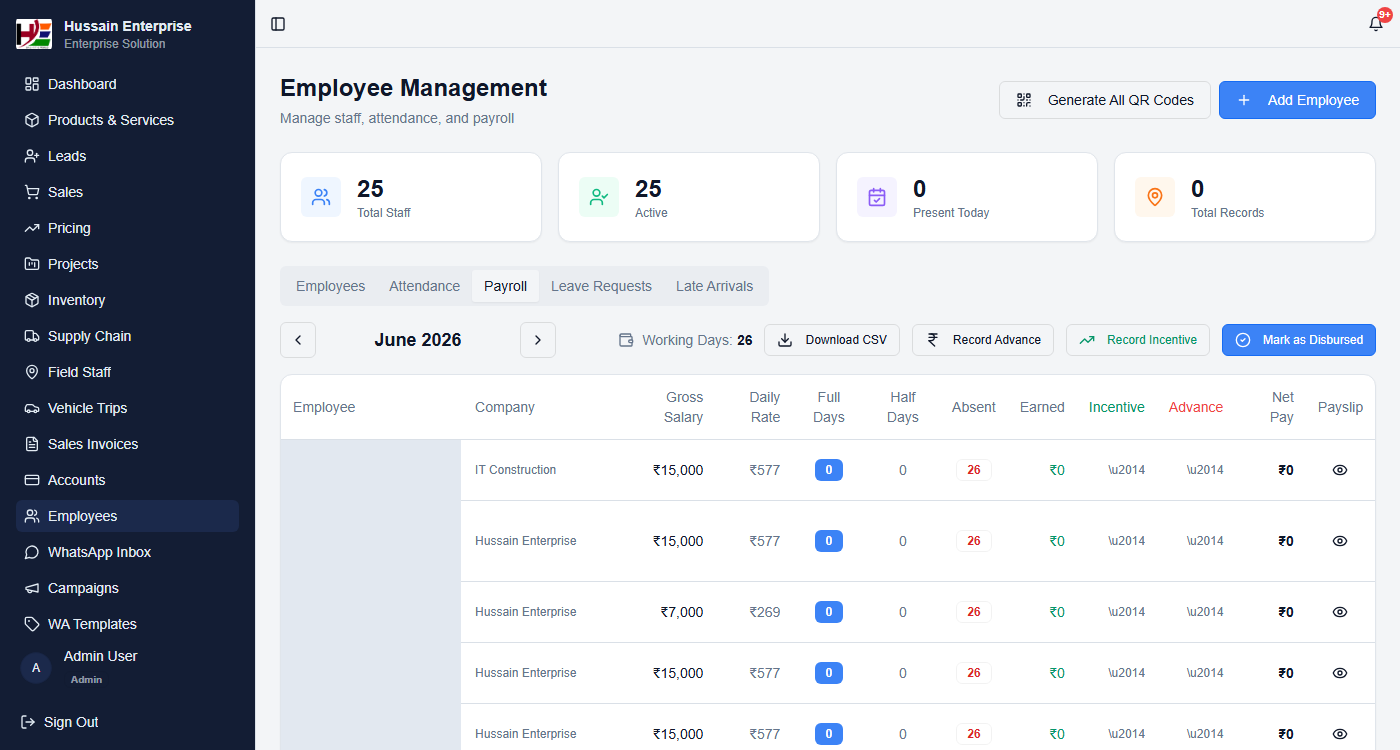
HR & Payroll
Manages the complete employee lifecycle — onboarding and master data, daily attendance, leave management, and monthly payroll processing. Before ERP, attendance was on paper registers and payroll took 2–3 days of manual Excel work.
Employee Master with full profile
Digital Attendance Tracking
Kiosk Mode — QR-code based check-in
Leave Management & approvals
Monthly Payroll Processing
Payslip PDF generation
Employee ID Card with QR code
Employee self-service portal
Employee names and contact details have been redacted from these screenshots for staff privacy.
Real-world impact: Paper attendance registers were replaced by QR-code kiosk check-in. Payroll processing that took 2–3 days now runs in under 1 hour with zero arithmetic errors.
Module 06
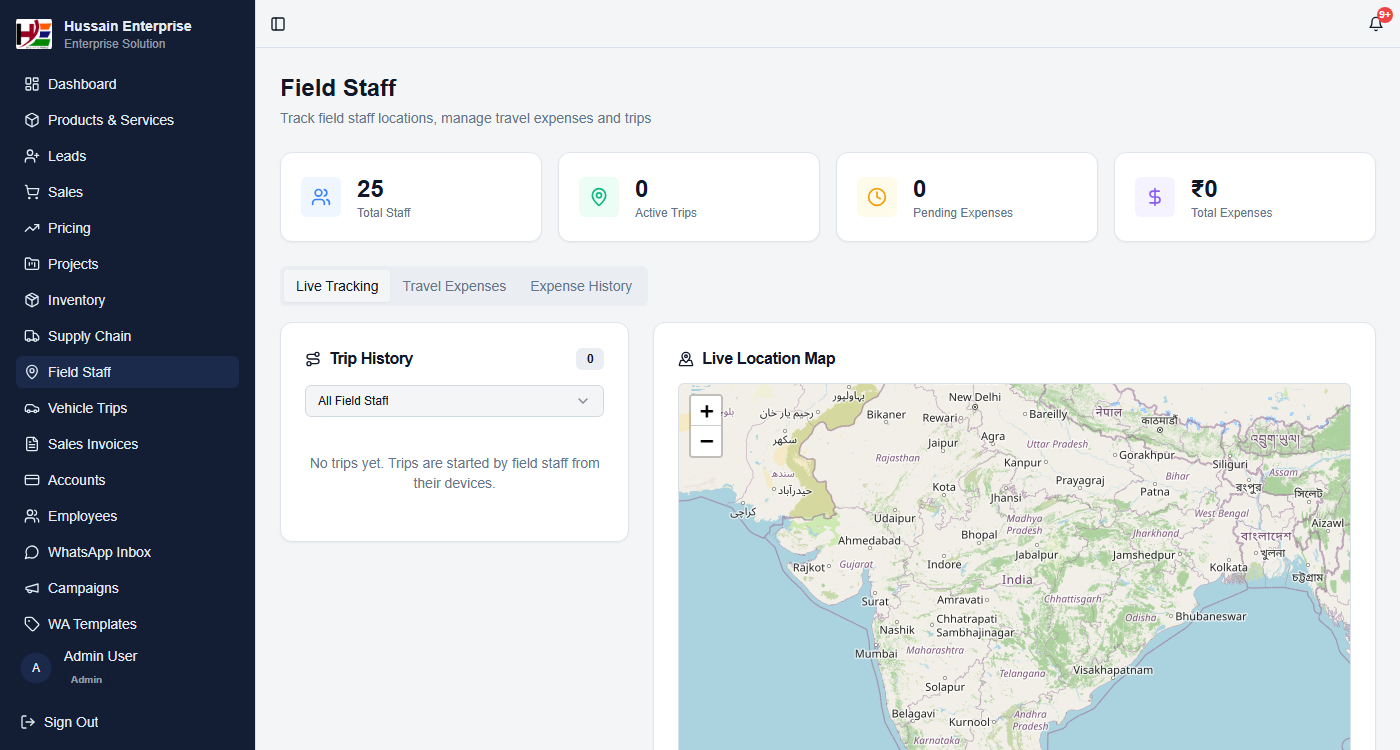
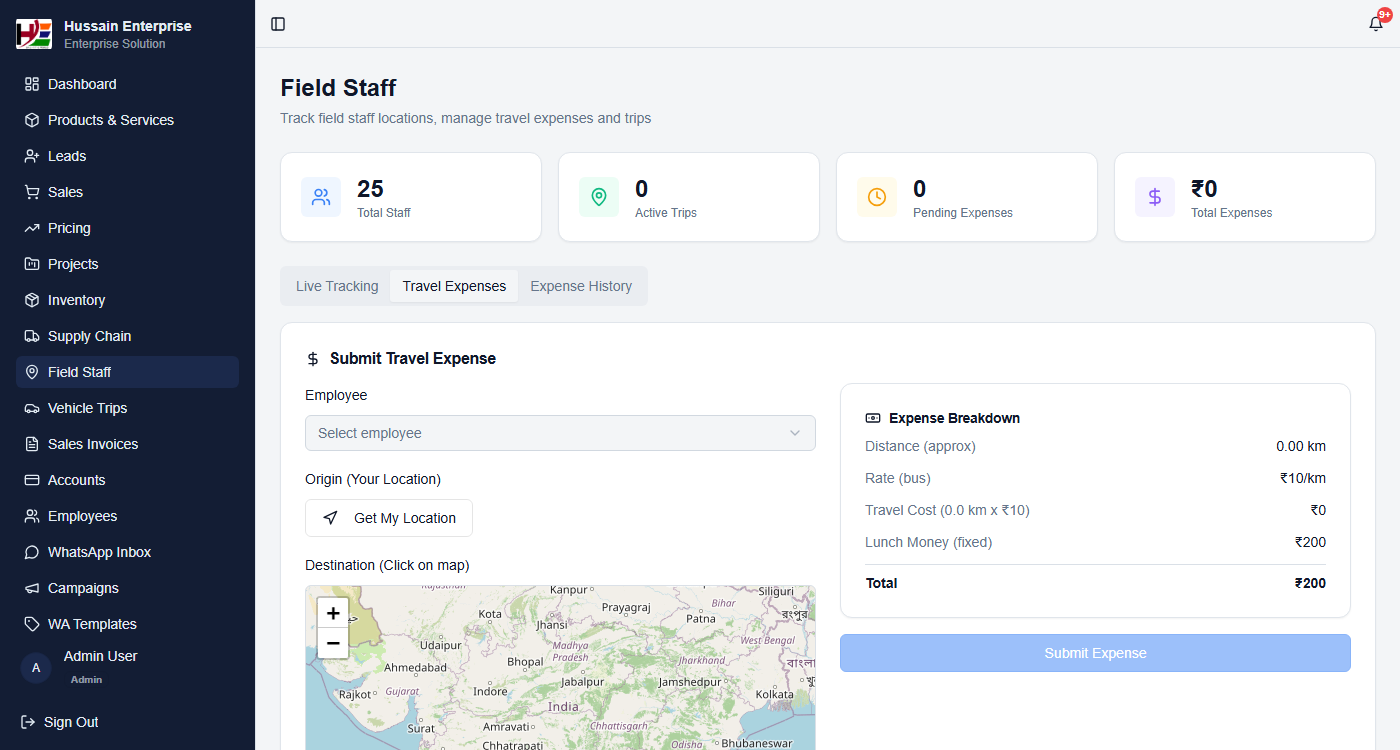
Field Staff & GPS Tracking
Real-time GPS location tracking, trip management, and travel expense processing for ITFI's field personnel. Before ERP, there was no way to verify whether a field visit had occurred or track travel expenses systematically.
Field Staff Profiles
Live GPS Location Map
Trip History per staff member
Distance-based expense calculation (₹/km)
Travel Expense submission (geo-calculated)
Expense approval workflow
Real-world impact: Sales managers can verify scheduled field visits actually took place. Field visit data automatically feeds back into CRM follow-up tracking, closing the loop between field activity and the sales pipeline.
Module 07
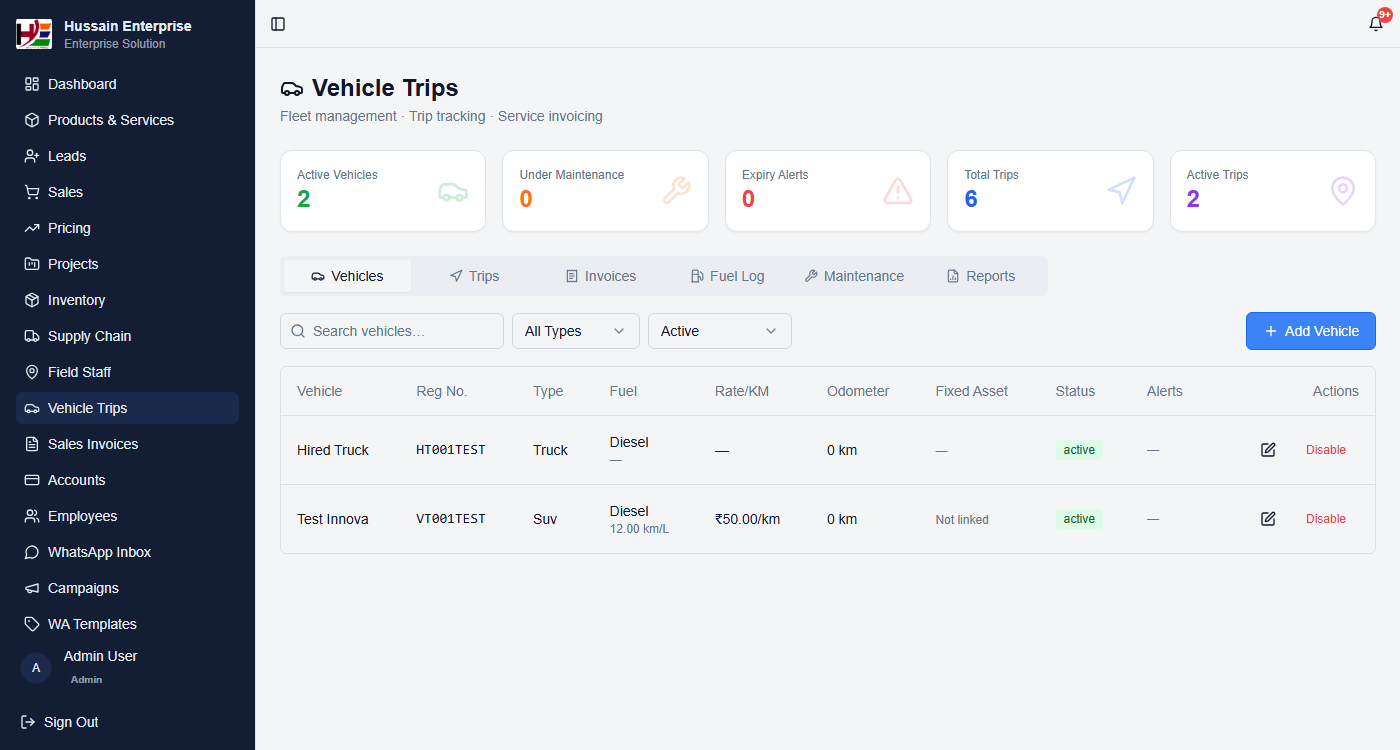
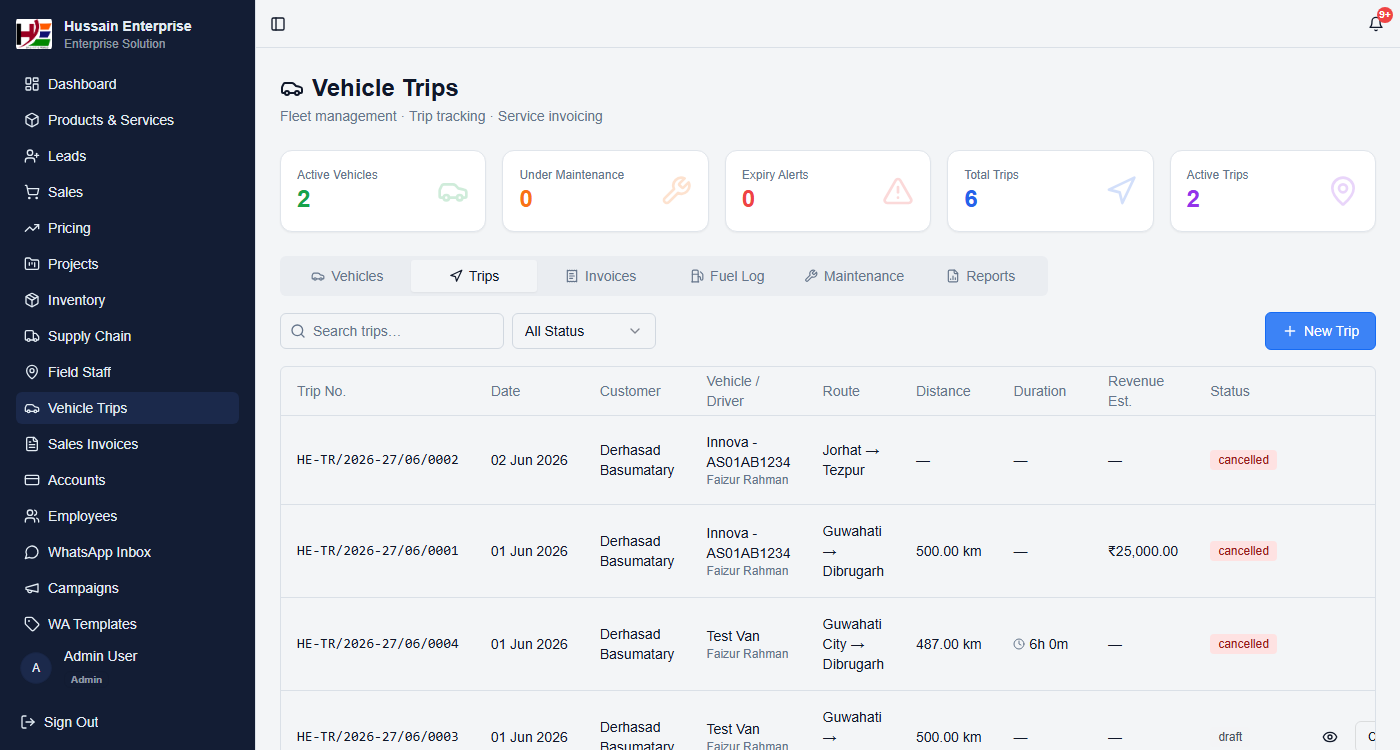
Vehicle Trips & Fleet Management
Complete fleet visibility — every trip from booking through completion, fuel consumption, maintenance schedules, and invoicing. Before ERP, fleet costs were untracked and absorbed into miscellaneous expenses.
Vehicle Master with fuel type & KM rates
Trip Management — booking to completion
Fuel Log per vehicle
Maintenance Log & scheduling
Trip Invoicing linked to AR
Fleet P&L per vehicle
Real-world impact: Fleet costs that were previously invisible now have complete visibility through per-trip profitability analysis and fuel efficiency metrics. Trip invoicing integrates directly with Accounts AR.
Module 08
Reports & Analytics
A comprehensive real-time visibility layer across all business functions. Before ERP, business reviews required days of manual data compilation from multiple sources, with effectively zero visibility between reporting cycles.
Live Operations Dashboard (all KPIs)
Period Sales & Profit Reports
Product Sales & Profit Report (by SKU)
Customer & Supplier Aging Reports
Sales & Purchase Register (GST-ready)
CSV Export for all reports
Real-world impact: Management moved from zero operational visibility to a real-time dashboard accessible from any device. Product profit reports revealed thin-margin SKUs, directly enabling targeted supplier renegotiations.
Reports Index
Live Operations DashboardLive
Period Sales & ProfitLive
Product Profit by SKULive
Customer Aging ReportLive
Supplier Aging ReportLive
Sales & Purchase RegisterGST
CSV Export — All Reports.csv
Illustrative representation of the Reports & Analytics module's report index — no screenshot supplied for this module.
Module 09
WhatsApp Integration & Communication
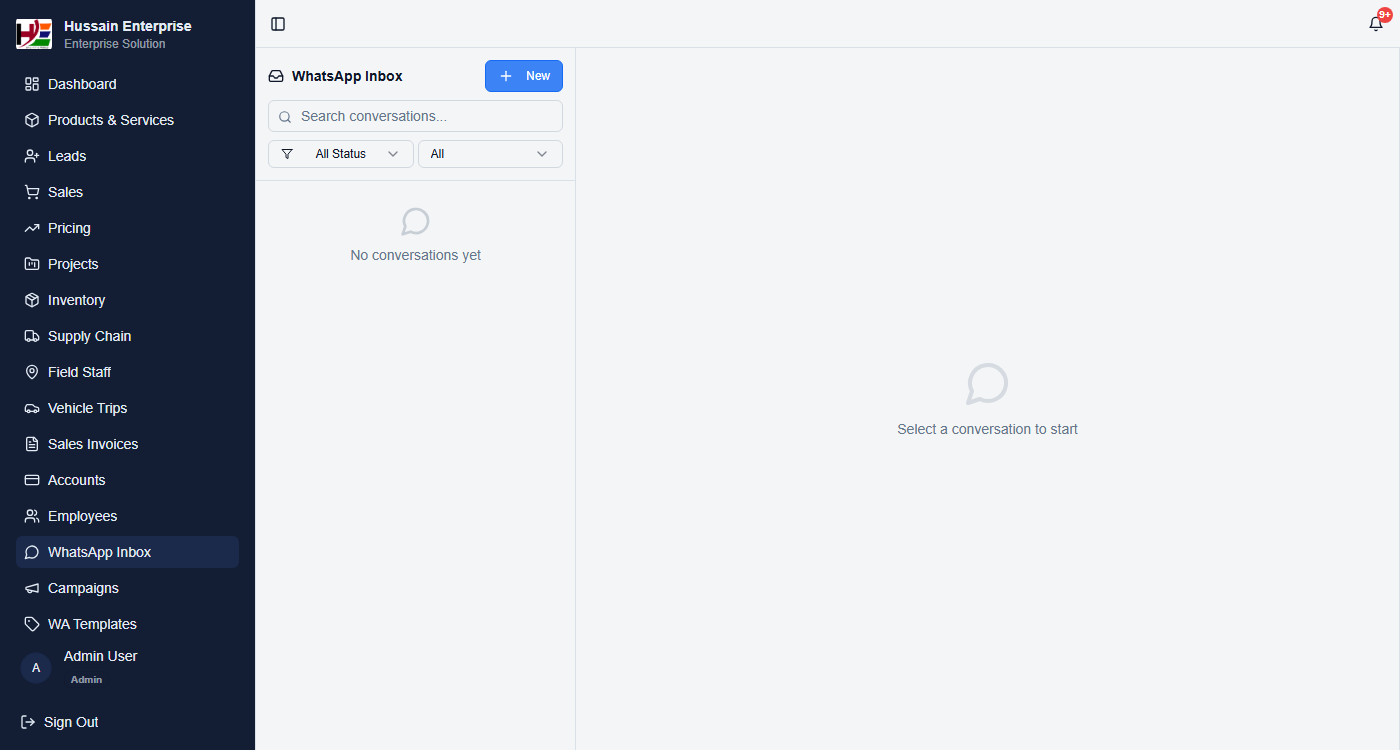
Connects ITFI's ERP workflows to the WhatsApp Business API, enabling automated customer communications, transactional alerts, and a centralized inbox for managing customer conversations on their preferred channel.
WhatsApp Business API Webhook Integration
WhatsApp Inbox — centralized view
Message Template Sync & Campaigns
Automated Transactional Alerts
Real-world impact: Customer communication for quotation follow-ups, order confirmations, and payment reminders now reaches customers on WhatsApp — the channel where ITFI's customers are most responsive.
Module 10
Audit Trail & Security
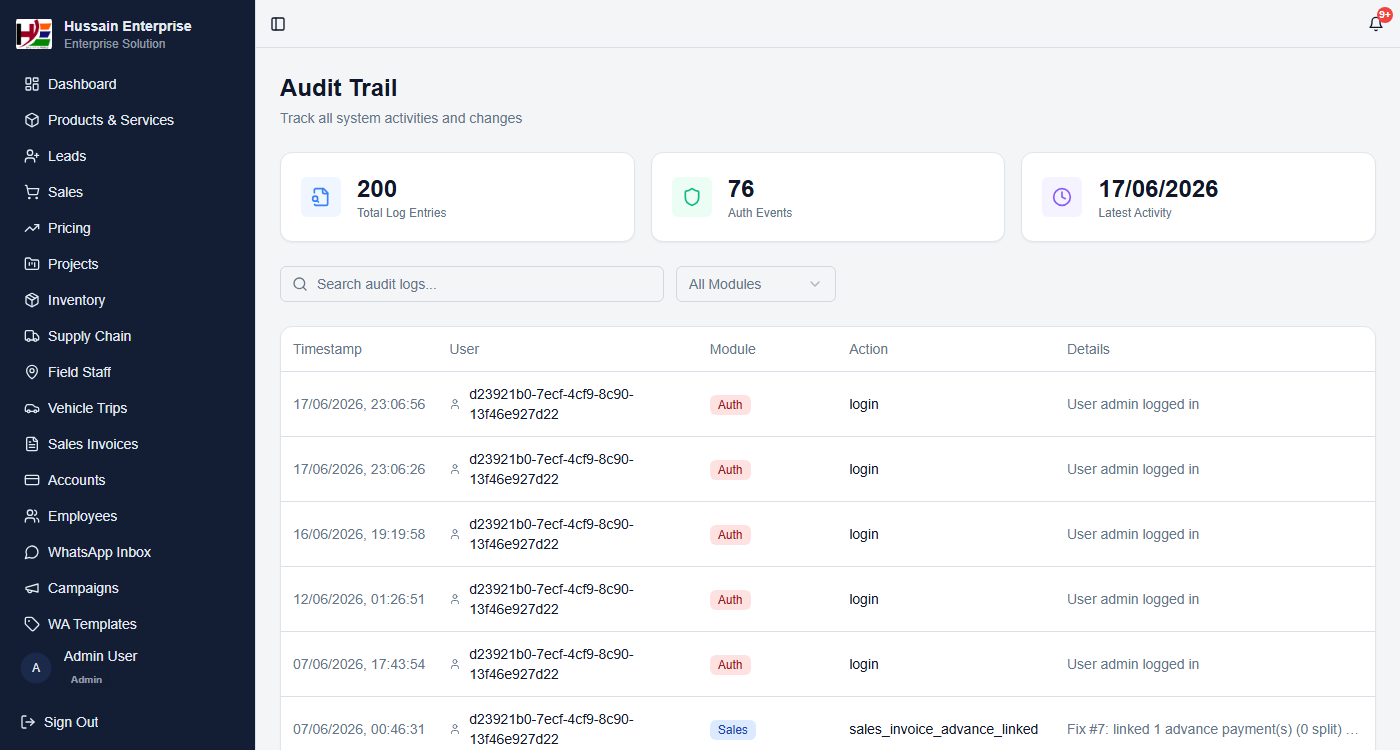
Complete system accountability through immutable transaction logging, role-based access control, session management, and IP logging. Before ERP, there was no way to determine who had changed a record, when, or what the previous value was.
Full Audit Log — all create/update/delete
Role-Based Access Control (5 user types)
Session Management & IP logging
Sub-second lookup across all log entries
Real-world impact: When a pricing error occurred on a live invoice, the audit trail identified exactly who had changed it, at what timestamp, from which IP address, and what the previous value was — in under 30 seconds.
Implementation Approach
Mapped to ITFI's real operations, not a generic template
The implementation followed ITFI's actual operational flow rather than a generic ERP deployment template. Each phase mapped directly to a real business function and its cross-module dependencies.
Phase
Approach
1. Operational Mapping
Manual workflows across procurement, sales, inventory, finance, HR, field operations and fleet were systematically mapped into ERP module specifications.
2. Custom Platform Build
Developed ground-up using Node.js + Express, React + TypeScript, and PostgreSQL — no off-the-shelf components or templates.
3. Workflow Integration
Sales orders, purchase requests, GRNs, FIFO lots, challans, invoices, payments, payroll and reports connected through shared database relationships.
4. Hosted Deployment
Deployed on a private Ubuntu VPS with PM2 process management for uptime and automatic restart on failure.
5. Role-Based Rollout
Access organized by five distinct user roles, with permissions configured at the route level.
6. Training & Handover
Module-by-module training conducted with each user group, with role-appropriate interfaces to minimize onboarding time.
Solutions Implemented
Seven core solutions engineered into the platform
Solution
Business Improvement Delivered
Unified ERP Platform
All 10 modules share one PostgreSQL database, creating a single source of truth and eliminating duplication.
GST-Aware Document Generation
Quotations, invoices, challans, POs, GRNs and payslips generate professional PDFs with GST breakdowns and FY-aware numbers — fully automated.
FIFO Lot Engine
Purchase cost locked at GRN time and consumed oldest-first at dispatch, giving accurate, auditable COGS for every sale.
Real-Time Dashboards & Reports
Live KPIs, sales performance, profit by product, customer aging, and GST registers from any device at any time.
Role-Based Access & Audit Trail
Every create/update/delete logged with user identity, timestamp, module, action and IP address.
Self-Hosted Deployment
Fully owned and self-hosted — no recurring per-user SaaS fees, no vendor lock-in, full data sovereignty.
Auto-Procurement Trigger
A confirmed sales order that creates a stock shortfall auto-generates a purchase request — reactive to proactive procurement.
Results & Outcomes
Measured, before-and-after improvement across ten metrics
The following outcomes represent the measured and observable improvements delivered by the ERP system, based on before-and-after comparison of the same business processes.
Metric
Before ERP
After ERP
Quotation Preparation Time
30–45 minutes
Under 3 minutes
Stock Reconciliation
Days of manual investigation
Real-time traceability by GRN lot
P&L Availability
Quarterly — external CA, weeks of delay
Live, self-serve at any moment
Payroll Processing
2–3 days, manual Excel calculations
Under 1 hour, zero arithmetic errors
Invoice Generation
Manual, raised next day
Automatic on dispatch confirmation
AR Outstanding Visibility
Paper notebook
Real-time aging report by customer
Audit Capability
None
Full trail, sub-second lookup
Document Numbering
Manual, error-prone
Auto, FY + month aware (IST timezone)
GST Register Preparation
Days of manual compilation
Minutes — export ready
Multi-location Stock Visibility
Not possible
Real-time per warehouse
Technical Highlights
Four engineering decisions with direct operational impact
01
FY + Month Segmented Numbering
All documents carry a structured reference incorporating financial year, month segment, and sequential counter, computed in IST timezone — e.g. HE-Q/2026-27/04/0001. Enables clean year-end closings and historical backfill without number conflicts.
02
FIFO Lot Engine
Purchase cost is locked at GRN time and stored against a specific inventory lot. At dispatch, inventory is consumed oldest-first, and its exact purchase cost is applied to COGS — margin figures always reflect actual procurement economics.
03
Historical Date Backfill
Business date selectors on all transaction forms allow entry of past-dated transactions — critical during migration, when historical data needed entry without disrupting current-period sequential numbering.
04
Zero Third-Party SaaS Dependency
No dependency on third-party SaaS for core functions. Self-hosted architecture means no per-user licensing fees, no external data sharing, and no risk of disruption from third-party pricing changes.
Conclusion
A complete digital transformation, fully owned by the client
The ERP system delivered to IT Futuristics Industries Pvt. Ltd. represents a comprehensive digital transformation of a mid-sized Indian trading and distribution business — moving ITFI from paper registers, WhatsApp messages, and isolated spreadsheets to a fully integrated, real-time digital operation with complete visibility across every business function.
The system was built specifically for the realities of Indian SME operations: GST-aware at every document touchpoint, FIFO-accurate for inventory costing, and designed for the field conditions of a trading and distribution business in Assam — including mobile browser access for field staff, QR-code based attendance, and WhatsApp-integrated customer communication. Most significantly, the platform is fully owned, self-hosted, and carries no ongoing per-user licensing cost.
Running Your Business on Spreadsheets? Let's Build the Platform It's Outgrown.
BoroTech Solution designs and builds fully custom, self-hosted ERP systems tailored to how your business actually operates — not a generic template.